Sunday, September 28, 2008

The light of the hidden world


The last two mornings I have awoken to see early morning mist veiling the land. As the sun declines in the sky and the summer heat dissipates it is as if the earth becomes coy and shy. She cloaks herself in mystery and becomes all the more beautiful. In response the trees put on a glorious display - before they are revealed in all their winter beauty before the darkening sky.

Is it just me or is the light of the hidden world brightening earlier than usual? Maybe it is because I am getting older, or that we are now under a new moon, or maybe it is true. Every evening this week I have been welcomed home from work by a lone crow on the drive who has eyed me with intelligent curiosity before flying onto the garage roof, her eyes following me as I enter the house; utter magic. 

As people regret the passing of summer it is good to rejoice in the turning of the year. To look forward to Samhain, to the thinning of the veil. As winter approaches and the robins and wrens busy themselves in the garden I look forward to a time of candles, open fires and story telling by the hearth. But above all a time to enter the silence of the dark and be touched by the beautiful light of the hidden world.

Labels: , , , ,

Sunday, March 23, 2008

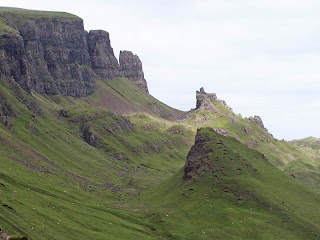
The Inaccessible Pinnacle


My love for the liminal places and ancient stories of Brighid's Isles has, of late, led me to a discovery of Celtic Languages. I am currently attending Irish classes and each week the teacher asks us all to tell a story in Irish. I love this, for storytelling is at the heart of community and tradition and I have long held that truth is to be found primarily in story.

I have just finished watching a very special film, Seachd, The Inaccessible Pinnacle. It is the first full length feature film ever to be produced in Scotch Gaelic. The DVD has subtitles in English, Irish and Welsh so it is boon for anyone wanting to increase their vocabulary of Celtic language. But this is also a powerful film in its own right. 

Seachd has an interesting subtitle, Lan fhirinn na sgeoil (truth is in the story). Aonghas is a boy painfully coming to terms with the death of his parents in an accident on a mountain. He and is siblings are raised by their grandparents in the Hebrides. His grandfather is a storyteller. For him, truth, tradition, culture, magic, all that is of value is to be found in story. Throughout the film the grandfather tells powerful ancient tales to the children. Tales that are set against the stunning scenery of the Highlands and Islands. Tales that hold valuable lessons for the children. For Aonghas these tales are merely the distraction of an old man, dead words in an old book. He drifts away from his grandfather and seeks consolation in the "real world". There is a moment when Aonghas argues with his grandfather in English and attempts to run away to Glasgow. 

As a man Aonghas fulfills his wish, moves to Glasgow and makes his way in the world. Then he is called back to the Hebrides where his grandfather is terminally ill in hospital. With what strength he has left the grandfather leaves the hospital with Aonghas and takes him to the mountain where his parent's died, determined that he will not lose the most precious thing a person can have - a place in a living tradition.

On the DVD there is an interview with Aonghas Padraig Caimbeul, the Gaelic writer and poet who plays the grandfather in the film. In this interview Aonghas tells us that every word spoken in Gaelic is a a triumph and a victory, a thing of beauty and strength. Today, there may only be 58,000 people who can speak Scotch Gaelic but every word spoken by them means that the story and the tradition and the culture is part of a living present. He talks about another storyteller who was asked how he remembered oral stories that were so long they took several nights to tell. The storyteller replied that it is easy, just look at the stones of the wall and the whole story is laid out in the stones.

So, in truth, we all learn who we really are, the meaning of life and of death, through the stories we hold in our hearts. Stories make the wisdom of the past active in the present. Stories hold eternal truths that are a stronghold against the worm-tongue words of politicians. A community can be most fully measured by the stories it holds dear.

Today the old stories are very much alive. The Goddesses are once more present in our world through the stories we tell about them. Stories that jump from heart to heart bearing the truth that tells us who we are and secure in who we are we can scale the inaccessible pinnacles of life.


Labels: , ,

Wednesday, October 17, 2007

Laa Souney


The Isle of Man is a small island that stands at the very centre of the British Isles. It has its own Celtic culture and language which is seeing something of a revival. With Samhain approaching I thought it would be interesting to look at the tradition of this small community. On the Isle of Man the Celtic New year is called Sauin, or Laa Souney, in Manx and Hollantide in English. Laa Souney literally means November Day.

The House of Manannan museum's presentation on Celtic life includes an interesting piece about the Goddess Breeshey (Bride) passing by all the houses of Man on Laa Souney to bless them for the coming winter. To catch a glimpse of Her passing was seen as a special blessing.

Sauin's association with the death of the old year, ancestors and hopes for the new year can be seen in two customs recorded on the island.

The ashes of the fire were carefully swept to the hearth and evenly spread by the women just before they retired to bed. In the morning they looked for marks in the ashes. If these marks pointed to the threshold there would be a death in the family but if they pointed away from the threshold there would be a marriage.

Young women would listen at a neighbour's door with salt in their hands and water in their mouth. It is said that the first name they heard would be that of their future husband.

In recent times Laa Souney has given way to Hop-tu-naa (Halloween) but a traditional rhyme still tells of the moon, visits to the well, feasting on a heifer and the possibility of meeting a witch.

This is old Hollantide night;
The moon shines bright;
Cock of the hens;
Supper of the heifer;
Which heifer shall we kill?
The little speckled heifer.
The fore-quarter,
We'll put in the pot for you.
The little hind quarter,
Give to us, give to us.
I tasted the broth,
I scalded my tongue,
I ran to the well,
And drank my fill;
On my way back,
I met a witch cat;
The cat began to grin,
And I ran away.
Where did you run to?
I ran to Scotland.
What were they doing there?
Baking bannocks and roasting collops.

Labels: ,